Chamique featured in Sports Illustrated’s “Where Are They Now?”

SI_WATN_7_2014

Sports Illustrated’s Andrew Lawrence brings readers up to speed on Chamique’s life since her 2012 incident with the law and her diagnosis of bipolar II disorder in 2013. Lawrence writes that Chamique hopes to make mental health issues “the cornerstone of her non-profit organization that will focus on building mental health wellness programs and expand her audience beyond the faith-based groups in the southeast with whom she frequently visits.”

Read the full article here!


SLAM Magazine catches up with Chamique and Mind/Game

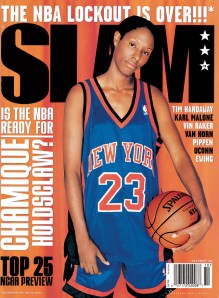
SLAM Cover SLAM Magazine featured Chamique in October 1998 when she was a senior at the University of Tennessee, soon to be picked number one overall in the WNBA draft the next year. Chamique was the first female to grace their cover and remains the ONLY female to have had the privilege. Check out this great article by Adam Fleischer about her journey since her rise to stardom and what she’s working on now, including the production of Mind/Game. Go Chamique!

Mind/Game awarded grant by The Nathan Cummings Foundation

The Nathan Cummings Foundation

The Nathan Cummings Foundation recently awarded Kovno Communications a grant to assist with the production of Mind/Game: The Unquiet Journey of Chamique Holdsclaw. This grant was made possible by the generosity and encouragement of Richard Cummings and Roberta Friedman Cummings.

The Nathan Cummings Foundation “is rooted in the Jewish tradition and committed to democratic values and social justice, including fairness, diversity, and community.” Its namesake was the founder of the Sara Lee Corporation and his legacy is carried on largely by family. In its mission statement, the foundation declares its objective to “build a socially and economically just society that values nature and protects the ecological balance for future generations; promotes humane health care; and fosters arts and culture that enriches communities.”

The Nathan Cummings Foundation has been a longtime advocate of our film projects and we greatly appreciate their support!

Edward Snowden was inspired by watching The Most Dangerous Man in America!

Dissenter article

Daniel Ellsberg, after a recent discussion with NSA whistleblower Edward Snowden, says that the latter “hardened his resolve” after watching the Rick Goldsmith-Judith Ehrlich Academy-Award-nominated film.  According to The Dissenter (see video and full article here):

“Ellsberg said that Snowden had communicated to him that he had viewed the documentary, The Most Dangerous Man in America, which tells the story of how Ellsberg came to release the Pentagon Papers in 1971 and how President Richard Nixon tried to destroy him. Snowden apparently indicated to Ellsberg that viewing this film hardened his resolve to release NSA documents to the public.”

Ellsberg has often said that “courage is contagious.”  As for documentary filmmakers, you never know who is going to watch your film, and how it may influence the course of history!

Visit this update on the Most Dangerous Man website.

Rick Goldsmith guest speaker at Arkansas State University

Rick Goldsmith visitied Arkansas State University, Jonesboro, AR, Thursday, October 24, 2013.   His presentations to two journalism classes sparked lively conversations among the inquisitive and opinionated students and their guest presenter.  Goldsmith’s film The Most Dangerous Man in America: Daniel Ellsberg and the Pentagon Papers was then screened at 6:30pm, followed by a Goldsmith presentation and another spirited Q&A session following on: “National Security vs. the People’s Right to Know: From the Pentagon Papers to Wikileaks

Rick Goldsmith selected for Rosalynn Carter Fellowship

The Carter CenterIn July, Rick Goldsmith was selected for the coveted 2013-14 Rosalynn Carter Fellowship for Mental Health Journalism, for the production of his film, Mind/Game: The Unquiet Journey of Chamique Holdsclaw. Read Rick Goldsmith’s blog about Mind/Game on the Carter Center website.

The Carter fellowships were established to “develop a cadre of journalists who can have a significant impact on the public’s understanding of mental illnesses” as part of a larger program “to provide the public with accurate and balanced depictions of those with mental illnesses to reduce stigma and discrimination.”

The year-long fellowship will give Rick the opportunity to consult with, and receive training from, leading mental health and journalism experts, which will enrich the depth, impact and reach of his film.

For more on the fellowship, go to http://www.cartercenter.org/news/pr/mhj-fellows-2013-2014.html.